


Welcome to the REDcert² Information Page
Sustainability claims and sustainability labels can be found on many products today and often play an important role in consumers' purchasing decisions.
At the same time, it is not always immediately clear what a label actually means, which requirements must be fulfilled, or what exactly a specific claim refers to. The European Directive Empowering Consumers for the Green Transition (EmpCo) has further specified the requirements for sustainability claims and sustainability labels. Its objective is to provide consumers with transparent, comprehensible, and reliable information and to facilitate a better understanding of sustainability-related claims.
With this information page, we aim to provide you with a transparent insight into the REDcert² Scheme and the REDcert² Product Seals.
Here, you will find clear and accessible information about the scheme requirements, the certification process, the REDcert² Product Seals and Claims, as well as the most important terms and definitions. This will help you to understand the information behind a REDcert² certification and the meaning of the claims displayed on a REDcert² Product Seal.

REDcert² Scheme
What is the REDcert² Scheme?
REDcert² is a voluntary sustainability certification scheme for materials, products, and supply chains across various industries. It supports companies in transparently and credibly demonstrating compliance with defined sustainability requirements.
The scheme is applied, among others, in the food and feed industry, the chemical industry, and the processing industry. Materials and products can be certified at different stages along the supply chain. Independent certification bodies approved by REDcert regularly verify compliance with the defined scheme requirements.
The requirements of the REDcert² Scheme are laid down in the REDcert² Scheme Principles. They describe the criteria that companies throughout the supply chain must fulfil and form the basis for certification and independent verification.
Products certified in accordance with the requirements of the REDcert² scheme may be labelled with a REDcert² Product Seal.

REDcert² and EmpCo
What is the REDcert² Scheme?
REDcert² is a voluntary sustainability certification scheme for materials, products, and supply chains across various industries. It supports companies in transparently and credibly demonstrating compliance with defined sustainability requirements.
The scheme is applied, among others, in the food and feed industry, the chemical industry, and the processing industry. Materials and products can be certified at different stages along the supply chain. Independent certification bodies approved by REDcert regularly verify compliance with the defined scheme requirements.
The requirements of the REDcert² Scheme are laid down in the REDcert² Scheme Principles. They describe the criteria that companies throughout the supply chain must fulfil and form the basis for certification and independent verification.
Products certified in accordance with the requirements of the REDcert² scheme may be labelled with a REDcert² Product Seal.

Certification
How Does Certification Work Within the REDcert² Scheme?
REDcert² certification serves to independently and transparently verify compliance with the requirements of the REDcert² Scheme. Companies participating in the REDcert² Scheme must fulfil the applicable scheme requirements and demonstrate their compliance with them.
A REDcert² certificate is issued only after compliance with the requirements has been confirmed by an independent certification body. With this certificate, companies may trade, process, and market certified materials and products within the framework of the REDcert² Scheme.
Below, you can learn more about how REDcert² certification works, who verifies compliance with the requirements, and under which conditions a certificate is issued.

Certification
A REDcert² certification confirms that a company complies with the scheme requirements applicable to its area of activity. The basis for this is a successful audit conducted by an independent certification body approved by REDcert.

Certification Bodies
Independent certification bodies approved by REDcert verify compliance with the requirements of the REDcert² Scheme. Trained auditors conduct audits and review, among other things, operational processes, documentation, and the traceability of materials throughout the supply chain.

Scheme Participants
REDcert² can be applied at various stages of the supply and value chain. These include, for example, producers, processors, traders, and companies that manufacture or market materials and products.


REDcert² Product Seal
What Do the REDcert² Product Seals Mean?
The REDcert² Product Seals identify products that have been certified in accordance with the requirements of the REDcert² Scheme.
They make the underlying certification visible and present the related information in a transparent and comprehensible manner. The exact meaning of a label is determined by the respective product seal and the corresponding claim. The claim explains what the label refers to and which specific statement is associated with it.
Product Seal
The REDcert² Product Seal identifies products that have been certified in accordance with the requirements of the REDcert² Scheme. It makes the underlying certification visible. The exact meaning of the label is determined by the corresponding claim.
Claim
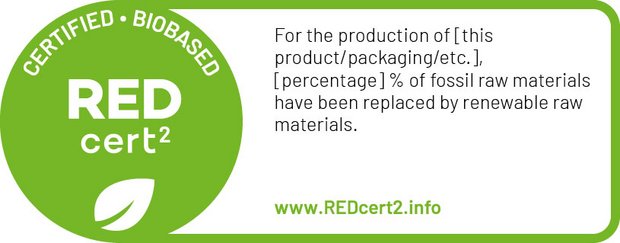
Claims provide additional specific information that complements the REDcert² Product Seal. They explain what the label refers to and which statement is associated with it. The REDcert² Product Seal must always be used together with a claim.
Label
The information provided on the Product Seal and in the claim describes the scope of the certification. This makes it possible to understand what the respective label refers to.
Transparency
Further information on the REDcert² Product Seals, claims, and the underlying scheme requirements is publicly available. This enables consumers to understand the meaning of the label.
Product Seal
If you see a REDcert² Product Seal on a product, the label should clearly and unambiguously explain what the certification refers to. This allows you to identify which part of a product is covered by the certification and what statement the label actually makes. The REDcert² communication requirements require a clear distinction between a product, a component, a material, and packaging.
Product Scope
The label must clearly indicate what the certification refers to. This may be the entire product, a specific component, a material, or the packaging. In this way, you can identify which part of a product is covered by the certification and what the respective statement refers to. For example, if only the plastic cap of a bottle is made from a certified sustainable material, the label must explicitly refer to the bottle cap. It must not create the impression that the entire bottle is covered by the certification.
Substitution Rate
The certified substitution rate used within the REDcert² Scheme indicates the proportion of conventional and/or fossil-based materials that has been replaced by certified sustainable alternatives during production. It does not necessarily refer to the total weight of the product, but rather to the respective material category or component that has been substituted. As a general rule, a substitution rate of at least 20% is required for the use of a REDcert² Product Seal.

Key Terms
Key Terms in the REDcert² Scheme
Various technical terms are used within the REDcert² Scheme that are important for understanding certification, REDcert² Product Seals, and Claims. Some of these terms can be found directly on Product Seals, in Claims, or in product-related information.
The following explanations help to better understand the meaning of these terms and labels and to comprehend the information associated with a REDcert² certification.
Sustainability
For REDcert, sustainability means the holistic and measurable promotion of environmentally friendly, economically viable, and socially responsible processes throughout the entire value chain. With its REDcert-EU and REDcert² certification schemes, REDcert is a reliable partner for companies seeking to implement sustainable practices in a transparent and traceable manner.
This is not only about complying with legal requirements, but also about the responsible use of resources, from agriculture and the bioeconomy to industrial production processes and circular economy concepts. The REDcert certification schemes support the promotion of renewable energy, the reduction of greenhouse gas emissions, and the protection of natural resources and ecosystems.
In addition, REDcert considers social and ethical aspects of production and places great importance on traceability and transparency. Through certification against REDcert standards, companies can demonstrate their commitment to sustainability and make a tangible contribution to conserving fossil resources and mitigating climate change.
For REDcert, sustainability is a process of continuous improvement that brings economic success into harmony with environmental responsibility and social justice.
What is Mass Balance and why is it necessary?
Mass balance is a strictly regulated accounting method used to track sustainable materials as they move through complex industrial manufacturing processes. In many modern industries, particularly in the chemical industry, production facilities are vast, integrated networks of pipelines and reactors. Within these systems, sustainable feedstocks and conventional fossil-based materials are fed into the same installations and become physically mixed during transport, storage, and processing.
Because it is technically very difficult to physically separate sustainable molecules from conventional ones once they have been mixed, mass balancing provides a mathematical and verifiable solution. The system is based on a strict accounting principle. A facility must accurately record the amount of sustainable material entering the process. Once production has been completed, the facility may only declare and sell a corresponding quantity of the final product as sustainable. Waste and losses generated during the production process are also taken into account and deducted from the input quantities. The principle is simple: what goes in must correspond to what comes out, ensuring that no double counting occurs.
The reason this method is so important is that building entirely new, separate production facilities exclusively for sustainable materials would cost billions and take decades. Mass balancing enables manufacturers to use their existing, highly efficient infrastructure to process sustainable materials immediately. This accelerates the transition away from fossil resources and allows sustainability benefits to reach the market and the environment much more quickly.
Extended Mass Balance: An optional form of mass balancing that, under specific circumstances, allows the transfer of credits between two geographically separated certified operating sites within a multisite certification of the same scheme participant. Such transfers are only permitted for chemically identical materials and only within a radius of 2,000 km or within national borders.
Where do the Sustainable Materials come from?
Products that are certified under the REDcert² scheme utilize feedstocks that fall into specific, strictly regulated sustainable categories to ensure a genuine environmental benefit:
Biomass: This category encompasses organic materials originating from biological sources. It includes primary agricultural and forestry products that are cultivated following strict land-use and biodiversity protections. Additionally, it includes biogenic waste and residues, such as leftover food scraps from households or restaurants, agricultural straw, and processing residues.
Biogenic: Biogenic under the REDcert2 scheme means that the raw materials for the production of this product come from biological processes, including biological waste but also renewable raw materials.
Recycled Materials: These are non-biogenic materials that have been recovered from waste streams. This includes both pre-consumer waste generated during industrial manufacturing and post-consumer waste discarded by households. By using mechanical or chemical recycling technologies, these waste materials are transformed back into valuable raw materials. Integrating recycled materials into the REDcert² scheme actively strengthens the circular economy, conserves virgin fossil resources, and prevents valuable materials from ending up in landfills or incinerators.
Sustainable Farming
Whether purchasing everyday products for a two-person household or selecting a sustainably produced chew toy for a dog, consumers want to be confident that the raw materials were cultivated without destroying natural habitats. The REDcert² scheme actively ensures that no highly biodiverse forests or carbon-rich peatlands are cleared to produce these materials.
To enforce this protection, farmers must provide strict evidence that no protected land has been converted into agricultural land since January 2008. In addition, agricultural producers must actively implement specific measures to protect soil structure, prevent erosion, and prevent agricultural runoff from polluting local groundwater.
Recycling under REDcert²
Under the REDcert² scheme materials can be recycled if a re-use can be excluded. Re-use is the process by which chemical substances, materials or products that have already been used are re-used for the same or a similar purpose without substantial modification. These processes are needed to ensure the most efficient use of virgin material and reduce losses. By minimising waste generation and optimising resource use, reuse contributes to a more efficient production system. Under the REDcert2 system, it is possible to recycle materials that are declared as waste after an industrial process (post-industrial waste) or after use by a consumer (post-consumer). This must be indicated in the description of the material.
Post Consumer Recyclat: Post-consumer recycled material (PCR) is recycled material that originates from products that have already been used by end-consumers and subsequently disposed of. The waste is then collected and processed. It is used to produce new products and save raw materials.
Post Industrial Recyclat: Pre-consumer recycled material (PCR)/post-industrial recycled material (PIR) is recycled material that originates from pre-consumer waste generated in the production of products and has never been used by a final consumer. There are clear requirements under REDcert2 when this material can be declared as waste and when it is reused.
Segregation
Production process using only sustainable material and not mixed with a stream of non-sustainable material. In this case, unlike the mass balance approach, the material is actually in 100% the product.
Controlled Blending
A production process in which a defined amount of sustainable material is mixed under conventional material and in which the handling of sustainable and unsustainable material can always be clearly predicted and this sustainable fraction is actually present in the product.
Carbon Footprint and Renewable Electricity
Consumers increasingly prefer to make choices that actively reduce global greenhouse gas emissions, and the scheme provides transparent mechanisms to track this climate impact. The REDcert² scheme offers a voluntary module that allows companies to rigorously calculate and verify their exact greenhouse gas emissions. This calculation tracks the total carbon footprint from the initial cultivation or collection of raw materials all the way to the factory gate.
In addition to tracking emissions, companies can explicitly certify that their production processes rely entirely on 100% renewable electricity, such as wind, solar, or hydropower. This level of transparency allows consumers to easily identify products that actively support the transition to a low carbon economy.
Social Responsibility and Fair Labor
Environmental protection represents only one component of true sustainability, which is why the REDcert² scheme also strictly mandates social responsibility across the entire supply chain. Participating companies must acknowledge and uphold the fundamental workers' rights defined by the International Labour Organization.
This strict framework includes an absolute prohibition on forced labor and child labor, along with the guarantee of equal pay and comprehensive occupational safety. If the national laws in a producing country do not sufficiently cover these critical standards, independent auditors step in to verify compliance directly on site during their inspections.